Low-Cost NB-IoT Floodway Monitoring for Regional Queensland
Murweh Shire Council (MSC) manages 2,700 km of local roads and 639 km of State Controlled Roads, many of which are vulnerable to flooding due to the region’s flat topography and low flood immunity. After experiencing two significant flood events in 2024 and another in March 2025—with neighbouring local government areas suffering record-breaking inundation and devastation—MSC sought a cost-effective and scalable flood monitoring solution to improve local flood intelligence and disaster response.
To achieve this, MSC deployed low-cost, open-source flood monitoring devices across South West Queensland, leveraging Telstra’s NB-IoT network for reliable, wide-area connectivity. Each device costs less than $250 to procure and under $10 per month to operate, making the system affordable for widespread deployment, particularly for rural councils with limited budgets.
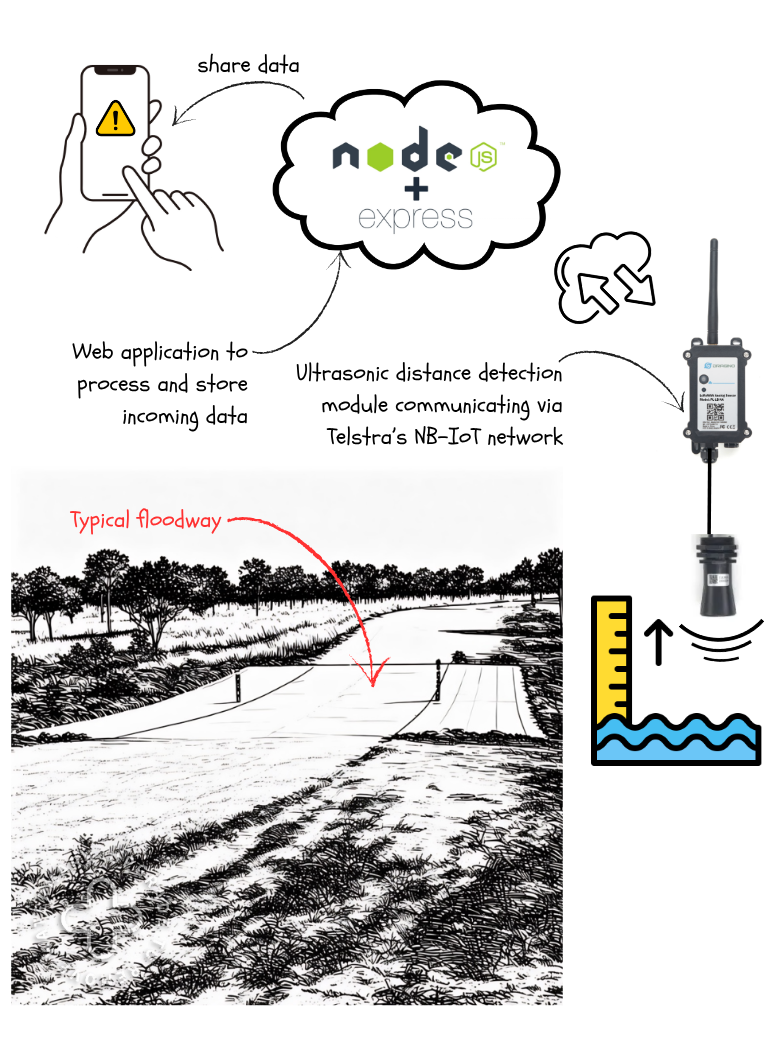
While commercial flood-monitoring systems offer advanced features, they are often expensive and rely on vendor-locked platforms and subscription models. MSC concluded that a greater number of simple, dedicated floodway monitors provided more practical value than fewer, high-spec units. The emphasis was on increasing the spatial coverage of flood intelligence rather than investing in advanced weather sensing equipment that might be unaffordable at scale.
To support this infrastructure and avoid dependency on third-party platforms, MSC developed an open-source web application that allows for public data access and integration. An accompanying API supports data sharing with external stakeholders such as the Department of Transport and Main Roads (TMR), the Bureau of Meteorology (BOM), and the QIT+ Guardian IMS platform. This ensures that the flood intelligence gathered can contribute to a broader emergency management ecosystem.
MSC’s approach demonstrates a viable, low-cost model for rural and regional councils to adopt scalable flood monitoring systems. By combining open-source tools, low-cost hardware, and existing telecommunications infrastructure, this project sets the foundation for a collaborative, state-wide flood intelligence network that could significantly enhance preparedness and response for future flood events.